
UK grocery price inflation dropped to 2.1% in the four weeks to August 9, hitting its lowest level since October 2024, according to the latest figures from Worldpanel by Numerator.
The slowdown marks the fifth consecutive month of easing food price inflation. Take-home sales growth cooled to 2.5% over the same period, with overall spend normalising following a spike earlier in the summer. Shoppers spent an average of £410 across the four weeks, a decrease of £14.24 compared to the previous month.
Consumer sentiment continues to diverge despite improving macro indicators. While 39% of households now report feeling financially comfortable—the highest level since November 2021—one in five families still report significant financial strain, with 30% of struggling households cutting back on travel and holidays to prioritise essential groceries.
Promotional activity reached a year-to-date high, with discounts accounting for 31.3% of all till sales.
Summer Heat Fuels Grazing and Freezer Demand
Sustained warm weather throughout late July and early August significantly reshaped consumer buying patterns, fueling demand for “no-cook” meals and frozen refreshments:
- Picnic and Grazing Staples: Dip sales jumped 23.3%, coleslaw rose 23.1%, and potato salad grew 22%. Chilled finger foods (+15.2%), quiche (+15.8%), and olives (+13.3%) also saw double-digit uplifts.
- Frozen Goods and Soft Drinks: Shoppers made an extra 6.2m visits to the freezer aisle compared to last year. Ice cream and sorbet surged 26.1%, frozen fruit spiked 48.1%, and soft drink spend climbed 15.1%.
- Suncare: Sun cream purchases leaped 58.4%, with under-45s driving the majority of sales.
“The continued heat across the UK has certainly impacted the way people are eating and drinking,” said Sally Ball, business unit director at Worldpanel by Numerator. “Earlier this summer we saw that mealtimes were being pushed later in the day, with 13% of evening meals now eaten after 8pm.”
Supermarket Performance Breakdown
Online grocery remained the fastest-growing channel, recording an 8.3% increase in shopping trips, though average digital basket sizes fell slightly to £86.28.
Among individual retailers over the 12-week period to August 9:
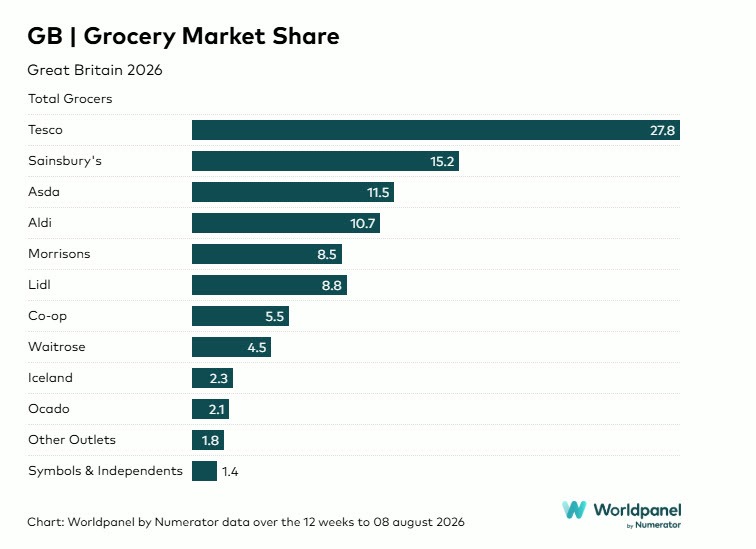
- Ocado: Fastest-growing grocer overall, up 13.1% to secure a 2.1% market share.
- Lidl: Achieved the largest market share gain (+0.5 percentage points to 8.8%) after attracting 736,000 new shoppers, with sales up 8.5%.
- Co-op: Rose 5.1%, reaching a 5.5% market share—its highest since September 2025.
- Sainsbury’s & Morrisons: Sales grew 3.5% and 3.3% respectively, each adding 0.1 percentage points of market share (Sainsbury’s at 15.2%, Morrisons at 8.5%).
- Waitrose & Iceland: Waitrose grew 2.8% (4.5% share) while Iceland grew 2.4% (2.3% share).
- Tesco: Maintained market leadership at 27.8% share with 1.8% sales growth.
- Aldi: Gained 488,000 new customers, lifting sales 1.1% to hold a 10.7% market share.
- Asda: Sales contracted slightly by 0.2% (11.5% share), marking its strongest year-on-year relative performance since March 2024.
The Numerator latest figures point to a UK grocery market entering a delicate transition phase, where cooling inflation is providing room to breathe but its not yet a total reset of consumer caution. While easing price pressures and sunny weather have fueled spontaneous, high-margin treats like frozen foods and premium grazing items, the record-high reliance on promotional deals (31.3%) proves that value remains the ultimate battleground. With the summer heatwave winding down and the back-to-school period looming, the divide between confident spenders and squeezed households will likely widen, meaning retailers who can balance attractive promotional offers with accessible own-label ranges will be the best positioned to capture basket share heading into autumn.